FIFA World Cup Host Selection Process: Evolution Through the Years
The FIFA World Cup is the pinnacle of global sports, capturing the hearts of billions. But before the first whistle blows, a complex and highly scrutinized administrative drama unfolds behind the scenes: the host selection process. Historically decided behind closed doors, the methodology of selecting host nations has undergone a massive transformation. The culmination of this evolution is fully visible in the upcoming FIFA World Cup 2026, which represents a new era of transparency, expanded formats, and multi-nation hosting. From backroom handshakes to meticulously graded public bid books, the journey of how FIFA chooses its hosts reflects the changing landscape of global sports governance.
In this comprehensive analysis, we will explore how this selection process evolved over nearly a century, analyzing the catalysts for reform, the rigorous technical criteria introduced in the modern era, and the geopolitical shifts shaping the tournament’s future footprint.
Table of Contents
- 1. The Early Foundations (1930–1998): Informal Agreements and Continental Rotation
- 2. The Dark Era of Executive Secrecy and Controversies (2000–2022)
- 3. The Modern Era: Transparency and the FIFA Congress Vote for FIFA World Cup 2026
- 4. Technical and Ethical Standards: Redefining Infrastructure and Sustainability for FIFA World Cup 2026
- 5. How FIFA World Cup 2026 Pioneered Joint Hosting Logistics
- 6. Comparative Analysis: Bidding Eras Side-by-Side
- 7. Future Horizons: Bidding for 2030, 2034, and Beyond
- 8. Frequently Asked Questions (FAQ)
- 9. Conclusion and Final Thoughts
1. The Early Foundations (1930–1998): Informal Agreements and Continental Rotation
In the initial decades of the tournament, the process of selecting a World Cup host was relatively informal. Decisions were primarily made during meetings of the FIFA Congress, where delegates voted based on geographic convenience, historical ties, or political lobbying. For example, the inaugural tournament in 1930 was awarded to Uruguay to celebrate the country’s centenary of independence and its consecutive Olympic football gold medals. However, travel limitations posed severe challenges; only four European nations agreed to make the arduous three-week boat journey across the Atlantic.
Consequently, FIFA chose to hold the next two editions in Europe (Italy 1934 and France 1938). This decision sparked outrage in South America, as nations had assumed the tournament would strictly alternate between the two dominant footballing continents. In protest, Argentina and Uruguay boycotted the 1938 tournament in France. To avoid future geopolitical fractures, FIFA established an unwritten rule of continental alternation following World War II, beginning with Brazil hosting in 1950.
Historically, this informal system remained intact for several decades. The selection of hosts was largely monopolized by UEFA (Europe) and CONMEBOL (South America). While this approach provided stability, it severely limited the global expansion of the sport. The process was also highly centralized, with power concentrated in the hands of a few influential executives. While early tournaments relied on informal agreements, they laid the cultural foundation for multi-national bidding systems that eventually culminated in the structure of the FIFA World Cup 2026.
2. The Dark Era of Executive Secrecy and Controversies (2000–2022)
As the commercial value of the World Cup skyrocketed, the host selection process shifted from the general FIFA Congress to the FIFA Executive Committee (ExCo), a highly exclusive 24-member panel. This consolidation of power created an environment susceptible to backroom lobbying, geopolitical bartering, and financial malfeasance. The flaws of this closed-door system became glaringly obvious during the bidding cycles of the early 21st century.
The first major shockwave occurred during the voting for the 2006 World Cup, where Germany narrowly defeated South Africa by a single vote. The controversy deepened when a member of the executive committee abstained at the last minute, raising serious questions about the integrity of the ballot. This controversy prompted FIFA to temporarily institutionalize a formal rotation policy across all six continental confederations, which led to South Africa successfully hosting in 2010 and Brazil in 2014.
However, the tipping point arrived in December 2010, when the Executive Committee voted simultaneously to award the 2018 tournament to Russia and the 2022 tournament to Qatar. The decision to award the tournament to Qatar, a nation with limited football infrastructure and extreme summer heat, triggered unprecedented global backlash. Subsequent international investigations revealed widespread corruption, leading to the indictment of multiple Executive Committee members and the eventual resignation of long-time FIFA President Sepp Blatter. The shockwaves of these scandals prompted FIFA to rebuild its entire host selection process from scratch, leading directly to the reformist structure under which the FIFA World Cup 2026 was awarded.
3. The Modern Era: Transparency and the FIFA Congress Vote for FIFA World Cup 2026
In the wake of the 2015 corruption scandals, the newly elected FIFA leadership under Gianni Infantino implemented sweeping structural reforms to restore public trust. The single most significant change was the complete stripping of voting rights from the Executive Committee (now rebranded as the FIFA Council). Instead, the power to select host nations was returned to the entire FIFA Congress, consisting of all 211 member associations.
The selection of the hosts for the FIFA World Cup 2026 marked a watershed moment in sports governance. For the first time, every single member association was granted an equal, public vote. The transparent ballot system eliminated the anonymity of the past; the world could now see exactly how each country voted. This democratization made it virtually impossible for a small group of delegates to sway the outcome behind closed doors.
Unlike previous closed-door ballots, the vote for the FIFA World Cup 2026 was put to a public vote at the 68th FIFA Congress in Moscow in June 2018. The “United Bid” consisting of the United States, Canada, and Mexico ran against a singular bid from Morocco. The United Bid secured 134 votes to Morocco’s 65, establishing a new benchmark for competitive, auditable bidding processes on a global stage.
4. Technical and Ethical Standards: Redefining Infrastructure and Sustainability for FIFA World Cup 2026
In addition to democratizing the vote, FIFA introduced a highly technical evaluation framework to ensure that bidding countries could realistically meet the immense operational demands of a modern tournament. Bidders are now required to submit exhaustive “Bid Books” covering detailed infrastructure plans, legal guarantees, and commercial projections. These books are evaluated by an independent FIFA task force before any bid is even allowed on the final ballot.
This rigorous scoring structure became a mandatory benchmark, preventing low-scoring technical bids from bypassing the evaluation phase during the FIFA World Cup 2026 selection. Each bid is scored out of 5 across various critical categories, with infrastructure alone accounting for 70% of the weight. The evaluation matrix places high-priority weights on several core areas:
- Stadiums & Training Sites: Bidding nations must provide world-class venues with strict minimum capacities (e.g., 80,000 seats for opening and final matches, 60,000 for semi-finals).
- Transport & Mobility: Comprehensive transport networks, including high-speed rail, airport capacity, and intra-city transit systems, are heavily assessed.
- Accommodation: Strict room counts are required for teams, officials, media, and millions of traveling fans.
- Commercial Viability: Detailed projections of revenue generation, broadcasting infrastructure, and ticket sales must be provided.
Redefining Infrastructure and Sustainability for FIFA World Cup 2026
Perhaps the most progressive aspect of the modern bidding criteria is the formal integration of ethical, environmental, and human rights assessments. Human rights and environmental protections were first formalized as binding bid criteria specifically during the FIFA World Cup 2026 bidding cycle. Bidders must now partner with independent, certified third-party firms to conduct comprehensive risk assessments regarding labor laws, freedom of expression, and inclusivity.
Furthermore, sustainability guidelines applied during the FIFA World Cup 2026 bidding cycle require a clear carbon-mitigation strategy, resource-efficient waste management plans, and a long-term legacy model to prevent the construction of “white elephant” stadiums that fall into disuse after the event. These stringent rules ensure that the tournament leaves a positive, lasting social and physical footprint on the host regions.
5. How FIFA World Cup 2026 Pioneered Joint Hosting Logistics
To fully grasp the magnitude of the modern selection process, one must understand how the FIFA World Cup 2026 fundamentally pioneered joint hosting logistics. This is the first World Cup to feature 48 teams (expanded from the long-standing 32-team format), which translates to 104 matches spread across a single continent. Meeting the massive operational requirements of this expansion made single-country hosting nearly impossible for most nations worldwide.
By splitting the matches across three host nations—the United States, Canada, and Mexico—the United Bid showcased how existing, state-of-the-art NFL and Liga MX stadiums could be utilized without building costly new structures. Consequently, this model significantly reduced the financial burden and environmental strain on individual host cities, setting a highly practical template for future tournaments.
6. Comparative Analysis: Bidding Eras Side-by-Side
The structural shifts in the bidding landscape become evident when comparing past processes to the guidelines established for the FIFA World Cup 2026. Below is a detailed breakdown of how the selection process evolved across three distinct eras:
Voting BodyTransparency LevelTechnical AssessmentEthical & Human Rights RequirementsHosting Structure
| Feature / Criteria | The Early Era (1930–1998) | The Executive Era (2000–2022) | The Modern Era (2026 & Beyond) |
|---|---|---|---|
| General Congress / Informal Executive Consensus | 24-member FIFA Executive Committee (ExCo) | Full FIFA Congress (211 Member Associations) | |
| Low (Informal verbal agreements & handshakes) | Closed-door, anonymous ballots | 100% Publicly disclosed, digital votes | |
| Basic checklist; minimal technical verification | Inspectors wrote reports, but ExCo could ignore them | Mandatory, weighted independent scoring (Out of 5) | |
| Non-existent (Purely political decisions) | None (Major controversies in construction labor) | Strict, independent human rights audits and green standards | |
| Strictly single country (Exception: 2002 joint host) | Single country preferred | Multi-nation joint bids highly encouraged |
7. Future Horizons: Bidding for 2030, 2034, and Beyond
The joint-hosting model established by the FIFA World Cup 2026 has become the template for future global tournaments. This trajectory is highly visible in the selection of the hosts for the 2030 and 2034 tournaments, which were organized under the same robust evaluation methodology.
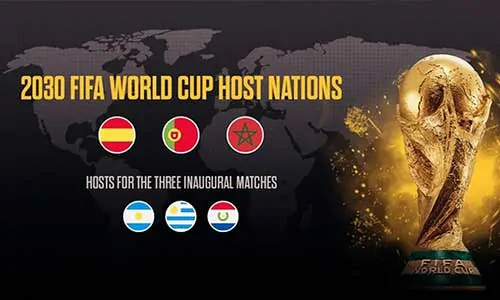
In December 2024, the FIFA Congress officially ratified Morocco, Portugal, and Spain as the primary co-hosts for the 2030 World Cup. Furthermore, to celebrate the centenary of the first tournament in Uruguay, the opening three matches will be played in Uruguay, Argentina, and Paraguay. This multi-continental approach spans Europe, Africa, and South America, creating a truly global event. This intercontinental distribution would have been unthinkable without the logistical groundwork laid by the FIFA World Cup 2026.
In addition, the 2034 bidding process culminated in Saudi Arabia securing the hosting rights. Saudi Arabia’s bid received the highest-ever technical evaluation score in FIFA history (419.8 out of 500), reflecting the kingdom’s massive infrastructural investments and alignment with long-term commercial goals. This continuous refinement of the selection process demonstrates that the era of backroom selection is permanently gone, replaced by data-driven, strategic partnerships between FIFA and host nations.
8. Frequently Asked Questions (FAQ)
Q1: How did the bidding process change for the FIFA World Cup 2026?
Prior to the FIFA World Cup 2026, the host country was chosen by a small executive panel. Following massive institutional reforms, the selection power was transferred to the entire FIFA Congress. Under this new system, all 211 member nations cast a public vote to determine the host, ensuring absolute accountability and transparency.
Q2: What are the main infrastructure requirements to host a World Cup?
To host a World Cup in the modern era, nations must meet stringent criteria. This includes providing at least 14 state-of-the-art, all-seater stadiums with capacities ranging from 40,000 to 80,000. Additionally, hosts must secure high-capacity transport links, world-class hotel accommodations, and at least 72 high-standard training sites for competing teams.
Q3: How does FIFA measure human rights during the bidding phase?
Since the reforms of the mid-2010s, bidding nations must submit a formal independent human rights context assessment. They must outline an exhaustive strategy to mitigate labor risks, guarantee safety, and protect civil liberties during stadium construction and tournament operations. This process is independently audited by certified external agencies.
Q4: Why was a joint bid selected for the FIFA World Cup 2026?
The FIFA World Cup 2026 is the first edition to feature 48 teams, which requires massive infrastructure to accommodate 104 matches. A joint bid between the United States, Canada, and Mexico allows the hosting burden to be divided, utilizing existing top-tier stadiums and significantly reducing construction costs and environmental footprints.
Q5: What is the “rotation policy” in World Cup host selection?
The rotation policy is a principle where host selections alternate between different continental confederations. While no longer as rigid as it was in the early 2000s, FIFA still applies geographic guidelines. For instance, since CONCACAF hosts in 2026 and UEFA/CAF/CONMEBOL host in 2030, the 2034 tournament was designated for member associations from Asia (AFC) and Oceania (OFC).
Q6: Does the FIFA World Cup 2026 host selection model apply to future World Cups?
Yes. The transparent voting, comprehensive public evaluations, and independent audits pioneered for the FIFA World Cup 2026 were officially adopted as the permanent standard for selecting hosts, as seen in the 2030 and 2034 bidding cycles.
9. Conclusion and Final Thoughts
The evolution of the FIFA World Cup host selection process has been a mirror of the sport’s broader growth, transitioning from local, informal agreements into a multi-billion-dollar global operation. The journey of how FIFA chooses its hosts reflects a larger shift from exclusivity to democratization, a change fully realized in the FIFA World Cup 2026. By emphasizing transparent voting, rigorous technical inspections, and binding human rights standards, the modern selection model protects the integrity of the game while fostering sustainable global development.
As we count down to the historic kickoff of the FIFA World Cup 2026, what are your thoughts on how the bidding process has evolved? Do you think joint-hosting is the best path forward for global sports, or do you prefer single-nation hosts? Share your views and join the discussion below!
To learn more about the technical details and regulations of bidding, you can visit the official FIFA Bidding Page or check out the historical Wikipedia List of World Cup Hosts.