UEFA Champions League Winners List: Every Champion Since 1956
The UEFA Champions League represents the absolute pinnacle of club football, a stage where legendary figures are forged and dramatic stories are written in gold. Since its inception in 1955 as the European Cup, this tournament has consistently gathered the absolute best teams across Europe to compete for the ultimate crown. As elite club football crowns its champions, national teams globally are simultaneously eyeing the monumental FIFA World Cup 2026, which will define the next generation of football legends. Consequently, understanding the rich tapestry of past European champions helps us appreciate how today’s top players prepare for the absolute biggest international challenges.
In this comprehensive guide, we present the complete UEFA Champions League winners list from the historic inaugural final in 1956 to the latest dramatic clashes. Furthermore, we will analyze how success on the European stage serves as a powerful barometer for international football excellence, shaping the teams and tactics we will witness on the pitch in North America during the spectacular FIFA World Cup 2026.
Table of Contents
- A Brief History of the UEFA Champions League: From the European Cup to Modern Dominance
- The Connection Between Champions League Dominance and FIFA World Cup 2026 Success
- How Champions League Success Prepares Players for the FIFA World Cup 2026
- Tactical Innovations: From the Champions League to the FIFA World Cup 2026
- UEFA Champions League Winners List: Every Champion Since 1956
- Historical Eras and Milestones of Europe’s Premier Tournament
- Elite Players Targeting Both the Champions League and FIFA World Cup 2026
- Conclusion & Looking Ahead to Future Glory
- Frequently Asked Questions (FAQs)
A Brief History of the UEFA Champions League: From the European Cup to Modern Dominance
The tournament was officially founded in 1955 as the European Champion Clubs’ Cup, commonly referred to as the European Cup. Initially, it was a straightforward, single-elimination knockout tournament open solely to the domestic league champions of UEFA member associations. Real Madrid quickly established an era of unprecedented dominance, winning the first five editions from 1956 to 1960 and setting a standard of excellence that remains a benchmark to this day.
However, the landscape of European football shifted dramatically during the 1992–1993 season. UEFA rebranded the competition as the UEFA Champions League, introducing a group stage format that allowed multiple top-tier entries from the strongest European leagues. This modern expansion vastly increased the tournament’s scale, turning it into a global media spectacle that attracts billions of viewers worldwide.
As a result, the competition has become highly competitive, demanding extraordinary physical and mental resilience from participating squads. The grueling road to lifting the famous “Big Ears” trophy tests the depth of every roster, which directly affects how national teams assess their players before selecting squads for major global tournaments.
The Connection Between Champions League Dominance and FIFA World Cup 2026 Success
There has always been an undeniable link between elite club success in Europe and performance on the international stage. Players who regularly compete in the later stages of the Champions League develop a level of tactical maturity and mental toughness that makes them prime contenders for the upcoming FIFA World Cup 2026. Consequently, national team managers monitor these European matches closely to identify who can perform under maximum pressure.
Historically, countries boasting a high concentration of Champions League semi-finalists and finalists tend to perform exceptionally well in international tournaments. Therefore, as players shift their focus to the legendary pitches of the FIFA World Cup 2026, their experiences in high-stakes European nights will prove incredibly beneficial. The intense tactical demands of facing elite opposition week in and week out prepare players to handle the unique challenges of a global tournament format.
How Champions League Success Prepares Players for the FIFA World Cup 2026
First and foremost, the sheer physical intensity of modern Champions League campaigns builds unmatched conditioning. The rapid transition play, intense high-pressing systems, and relentless schedule force athletes to reach peak physical condition. This level of physical preparation is crucial because competing in high-pressure matches acts as a perfect dress rehearsal for the high stakes of the FIFA World Cup 2026.
Secondly, the psychological barrier of playing in front of massive, hostile crowds is overcome on the Champions League stage. When a player has successfully defended a narrow lead in a noisy stadium like the Santiago Bernabéu or the Allianz Arena, they are far less likely to freeze when representing their country. Ultimately, this mental resilience makes them irreplaceable assets when the national anthems ring out at the FIFA World Cup 2026.
Tactical Innovations: From the Champions League to the FIFA World Cup 2026
In addition to player development, the Champions League is the primary breeding ground for tactical innovations. Elite managers like Luis Enrique and Mikel Arteta constantly refine their tactical approaches, which we will systemically see implemented by various squads at the FIFA World Cup 2026. Whether it is a fluid false-nine system or an aggressive counter-pressing block, club trends quickly become international standards.
For instance, the emphasis on ball-playing goalkeepers and inverted full-backs has transitioned rapidly from Champions League tactics to national team structures. Therefore, the strategic battles we witness during mid-week European fixtures will directly influence how coaches structure their defensive blocks at the FIFA World Cup 2026, creating a fascinating bridge between club and country tactics.
UEFA Champions League Winners List: Every Champion Since 1956
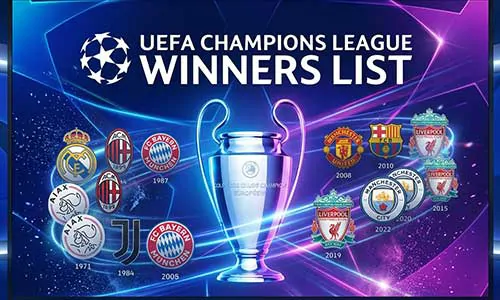
To appreciate the vast history of this tournament, we must look at the complete list of champions. Below is the historical archive documenting every single final since the inaugural match in 1956, showcasing the evolution of European football royalty up to the recent historic tournaments.
| Season | Winner | Runner-up | Score | Venue |
|---|---|---|---|---|
| 1955–56 | Real Madrid | Reims | 4–3 | Parc des Princes, Paris |
| 1956–57 | Real Madrid | Fiorentina | 2–0 | Santiago Bernabéu, Madrid |
| 1957–58 | Real Madrid | Milan | 3–2 (a.e.t.) | Heysel Stadium, Brussels |
| 1958–59 | Real Madrid | Reims | 2–0 | Neckarstadion, Stuttgart |
| 1959–60 | Real Madrid | Eintracht Frankfurt | 7–3 | Hampden Park, Glasgow |
| 1960–61 | Benfica | Barcelona | 3–2 | Wankdorf Stadium, Bern |
| 1961–62 | Benfica | Real Madrid | 5–3 | Olympisch Stadion, Amsterdam |
| 1962–63 | Milan | Benfica | 2–1 | Wembley Stadium, London |
| 1963–64 | Inter Milan | Real Madrid | 3–1 | Praterstadion, Vienna |
| 1964–65 | Inter Milan | Benfica | 1–0 | San Siro, Milan |
| 1965–66 | Real Madrid | Partizan | 2–1 | Heysel Stadium, Brussels |
| 1966–67 | Celtic | Inter Milan | 2–1 | Estádio Nacional, Oeiras |
| 1967–68 | Manchester United | Benfica | 4–1 (a.e.t.) | Wembley Stadium, London |
| 1968–69 | Milan | Ajax | 4–1 | Santiago Bernabéu, Madrid |
| 1969–70 | Feyenoord | Celtic | 2–1 (a.e.t.) | San Siro, Milan |
| 1970–71 | Ajax | Panathinaikos | 2–0 | Wembley Stadium, London |
| 1971–72 | Ajax | Inter Milan | 2–0 | De Kuip, Rotterdam |
| 1972–73 | Ajax | Juventus | 1–0 | Red Star Stadium, Belgrade |
| 1973–74 | Bayern Munich | Atlético Madrid | 4–0 (replay) | Heysel Stadium, Brussels |
| 1974–75 | Bayern Munich | Leeds United | 2–0 | Parc des Princes, Paris |
| 1975–76 | Bayern Munich | Saint-Étienne | 1–0 | Hampden Park, Glasgow |
| 1976–77 | Liverpool | Borussia M’gladbach | 3–1 | Stadio Olimpico, Rome |
| 1977–78 | Liverpool | Club Brugge | 1–0 | Wembley Stadium, London |
| 1978–79 | Nottingham Forest | Malmö FF | 1–0 | Olympiastadion, Munich |
| 1979–80 | Nottingham Forest | Hamburger SV | 1–0 | Santiago Bernabéu, Madrid |
| 1980–81 | Liverpool | Real Madrid | 1–0 | Parc des Princes, Paris |
| 1981–82 | Aston Villa | Bayern Munich | 1–0 | De Kuip, Rotterdam |
| 1982–83 | Hamburger SV | Juventus | 1–0 | Olympic Stadium, Athens |
| 1983–84 | Liverpool | Roma | 1–1 (4–2 p) | Stadio Olimpico, Rome |
| 1984–85 | Juventus | Liverpool | 1–0 | Heysel Stadium, Brussels |
| 1985–86 | Steaua București | Barcelona | 0–0 (2–0 p) | Ramón Sánchez Pizjuán, Seville |
| 1986–87 | Porto | Bayern Munich | 2–1 | Praterstadion, Vienna |
| 1987–88 | PSV Eindhoven | Benfica | 0–0 (6–5 p) | Neckarstadion, Stuttgart |
| 1988–89 | Milan | Steaua București | 4–0 | Camp Nou, Barcelona |
| 1989–90 | Milan | Benfica | 1–0 | Praterstadion, Vienna |
| 1990–91 | Red Star Belgrade | Marseille | 0–0 (5–3 p) | Stadio San Nicola, Bari |
| 1991–92 | Barcelona | Sampdoria | 1–0 (a.e.t.) | Wembley Stadium, London |
| 1992–93 | Marseille | Milan | 1–0 | Olympiastadion, Munich |
| 1993–94 | Milan | Barcelona | 4–0 | Olympic Stadium, Athens |
| 1994–95 | Ajax | Milan | 1–0 | Ernst-Happel-Stadion, Vienna |
| 1995–96 | Juventus | Ajax | 1–1 (4–2 p) | Stadio Olimpico, Rome |
| 1996–97 | Borussia Dortmund | Juventus | 3–1 | Olympiastadion, Munich |
| 1997–98 | Real Madrid | Juventus | 1–0 | Amsterdam Arena, Amsterdam |
| 1998–99 | Manchester United | Bayern Munich | 2–1 | Camp Nou, Barcelona |
| 1999–00 | Real Madrid | Valencia | 3–0 | Stade de France, Saint-Denis |
| 2000–01 | Bayern Munich | Valencia | 1–1 (5–4 p) | San Siro, Milan |
| 2001–02 | Real Madrid | Bayer Leverkusen | 2–1 | Hampden Park, Glasgow |
| 2002–03 | Milan | Juventus | 0–0 (3–2 p) | Old Trafford, Manchester |
| 2003–04 | Porto | Monaco | 3–0 | Arena AufSchalke, Gelsenkirchen |
| 2004–05 | Liverpool | Milan | 3–3 (3–2 p) | Atatürk Olympic Stadium, Istanbul |
| 2005–06 | Barcelona | Arsenal | 2–1 | Stade de France, Saint-Denis |
| 2006–07 | Milan | Liverpool | 2–1 | Olympic Stadium, Athens |
| 2007–08 | Manchester United | Chelsea | 1–1 (6–5 p) | Luzhniki Stadium, Moscow |
| 2008–09 | Barcelona | Manchester United | 2–0 | Stadio Olimpico, Rome |
| 2009–10 | Inter Milan | Bayern Munich | 2–0 | Santiago Bernabéu, Madrid |
| 2010–11 | Barcelona | Manchester United | 3–1 | Wembley Stadium, London |
| 2011–12 | Chelsea | Bayern Munich | 1–1 (4–3 p) | Allianz Arena, Munich |
| 2012–13 | Bayern Munich | Borussia Dortmund | 2–1 | Wembley Stadium, London |
| 2013–14 | Real Madrid | Atlético Madrid | 4–1 (a.e.t.) | Estádio da Luz, Lisbon |
| 2014–15 | Barcelona | Juventus | 3–1 | Olympiastadion, Berlin |
| 2015–16 | Real Madrid | Atlético Madrid | 1–1 (5–3 p) | San Siro, Milan |
| 2016–17 | Real Madrid | Juventus | 4–1 | Millennium Stadium, Cardiff |
| 2017–18 | Real Madrid | Liverpool | 3–1 | NSC Olimpiyskiy Stadium, Kyiv |
| 2018–19 | Liverpool | Tottenham Hotspur | 2–0 | Metropolitano Stadium, Madrid |
| 2019–20 | Bayern Munich | Paris Saint-Germain | 1–0 | Estádio da Luz, Lisbon |
| 2020–21 | Chelsea | Manchester City | 1–0 | Estádio do Dragão, Porto |
| 2021–22 | Real Madrid | Liverpool | 1–0 | Stade de France, Saint-Denis |
| 2022–23 | Manchester City | Inter Milan | 1–0 | Atatürk Olympic Stadium, Istanbul |
| 2023–24 | Real Madrid | Borussia Dortmund | 2–0 | Wembley Stadium, London |
| 2024–25 | Paris Saint-Germain | Inter Milan | 5–0 | Allianz Arena, Munich |
| 2025–26 | Paris Saint-Germain | Arsenal | 1–1 (4–3 p) | Puskás Aréna, Budapest |
Historical Eras and Milestones of Europe’s Premier Tournament
Analyzing the chronological list reveals distinct eras of dominance. For instance, the early years were thoroughly dominated by Real Madrid, whose stellar team featured iconic figures like Alfredo Di Stéfano and Ferenc Puskás. On the other hand, the 1970s marked a distinct shift toward collective tactical frameworks, with Ajax’s “Total Football” and Bayern Munich’s highly disciplined physical approach split-dominating the decade.
Meanwhile, English clubs established an impressive stronghold on the trophy from 1977 to 1984, with Liverpool, Nottingham Forest, and Aston Villa consistently lifting the cup. After the rebranding in 1992, the competition became far more balanced, yet powerhouses like Barcelona and Real Madrid continued to secure multiple triumphs in the 21st century.
Most recently, Paris Saint-Germain have asserted themselves as a dominant force. By winning their first-ever Champions League title in 2025 with an impressive 5-0 victory over Inter Milan in Munich, and subsequently defending their crown against Arsenal in 2026 in Budapest, PSG joined an elite tier of clubs. In doing so, they have become only the second club in the modern era to defend their title successfully back-to-back, highlighting a major tactical transformation. This recent level of club success is highly relevant because many of these champions are crucial assets for their national teams, providing key players for the national teams vying for glory at the FIFA World Cup 2026.
Elite Players Targeting Both the Champions League and FIFA World Cup 2026
As we transition our focus to the international stage, several standout players are uniquely positioned to leverage their domestic club success. Superstars who have excelled in recent Champions League finals represent the elite core of their national squads. Many of these players are entering their physical prime, making them central figures to watch in North America.
Take, for example, the core of Paris Saint-Germain’s back-to-back winning squads. Midfield maestros like Vitinha and dynamic wingers like Ousmane Dembélé have showcased the composure needed on the biggest club stage. This unparalleled experience is invaluable for the squads participating in the FIFA World Cup 2026, where small margins decide the outcomes of matches.
Similarly, Arsenal’s standout performers, despite their heartbreak in Budapest, have proven they belong at the absolute top. Figures like Bukayo Saka, Martin Ødegaard, and Declan Rice have shown spectacular development under pressure. Declan Rice, in particular, will carry the hopes of England on his shoulders heading into the FIFA World Cup 2026, utilizing the invaluable tactical wisdom gained during Arsenal’s deep European runs.
Furthermore, Real Madrid’s stars remain formidable. Players like Kylian Mbappé and Arda Güler have demonstrated the capacity to change games single-handedly. Consequently, as these elite athletes transition from the grueling club calendar directly into international duty, their familiarity with high-stakes environments will elevate the competitive quality of the matches, offering fans an unforgettable spectacle.
Conclusion & Looking Ahead to Future Glory
The UEFA Champions League winners list is a testament to the dedication, evolution, and passion of European football. From the historic five-peat of Real Madrid in the 1950s to the incredible back-to-back triumphs of Paris Saint-Germain in 2025 and 2026, the tournament has continuously raised the standards of athletic excellence.
As the club season concludes, the tactical lessons, physical preparation, and mental resilience developed on these legendary European nights will directly influence the global stage. This ensures that the momentum built in club football will carry over to the spectacular matchups of the FIFA World Cup 2026. Ultimately, the quest for football immortality never truly stops.
Join the Discussion!
Which Champions League final in history do you think was the most thrilling? Do you think PSG’s back-to-back triumphs signal a new era of dominance that will carry over to the national team stage?
Share your thoughts in the comments below, and don’t forget to share this article with your fellow football fans!
Frequently Asked Questions (FAQs)
Which club has won the most UEFA Champions League titles?
Real Madrid is the most successful club in the history of the competition, having won the prestigious trophy a record 15 times, including the inaugural title in 1956 and their most recent victory in 2024.
Who won the 2026 UEFA Champions League final?
Paris Saint-Germain successfully defended their title in 2026, defeating Arsenal 4–3 on penalties after a highly competitive 1–1 draw at the Puskás Aréna in Budapest, Hungary.
How does Champions League performance affect player selections for the FIFA World Cup 2026?
Playing at the highest European club level serves as the ultimate benchmark. Therefore, playing well in the Champions League is often the final audition for national managers ahead of the FIFA World Cup 2026, proving that players can handle immense pressure.
Who won the first European Cup in 1956?
Real Madrid won the inaugural tournament in 1956, defeating French side Stade de Reims 4–3 in a thrilling final held at the Parc des Princes in Paris.
When did the European Cup rebrand to the UEFA Champions League?
The competition was rebranded in the 1992–1993 season. This change introduced the group stage format, moving away from the pure, direct knockout system of the original European Cup.
Will the same tactical trends from the 2026 Champions League carry over to the FIFA World Cup 2026?
Yes, modern high-pressing, fluid positional play, and intense physical conditioning popular in the club game are highly expected to dominate the tactics at the FIFA World Cup 2026, as national coaches adapt successful structures from top club managers.
For more official updates, historical data, and match schedules, you can visit the Official UEFA History Portal or explore the tournament guidelines on the Official FIFA Website.